Launching Armature - Product Analytics for MCPs, Claude Connectors and ChatGPT Apps
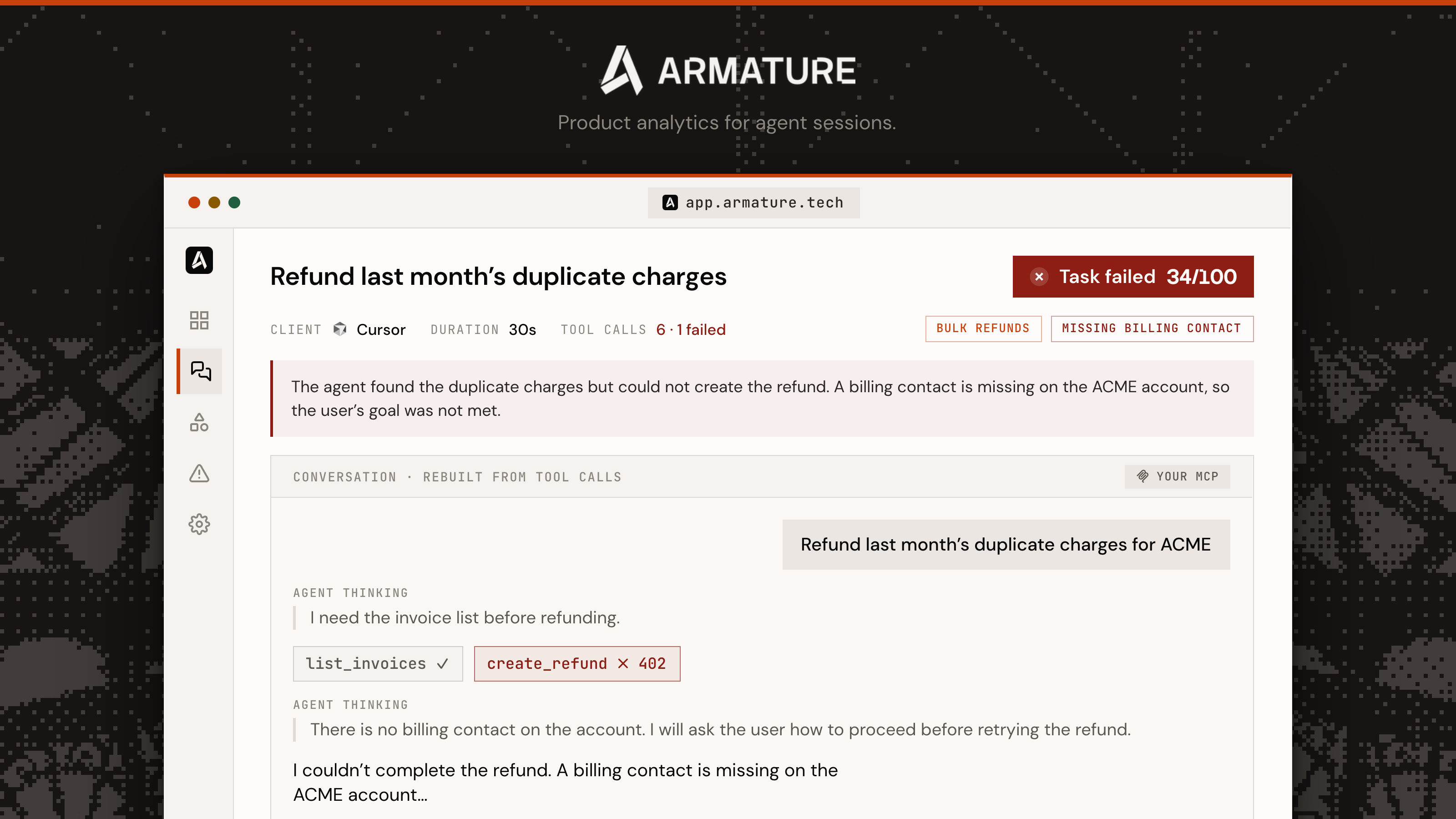
Today, we’re launching Armature - Product Analytics for agent sessions, so product and engineering teams finally understand what users actually ask their agent to do through their MCP.
Three lines of code capture intent and turn raw tool-call logs into reconstructed sessions: real user intent, agent reasoning, clustered use cases, and the failures costing you the most.
import { createMcpAnalyticsServer } from "@armature-tech/mcp-analytics";

// wrap the factory that creates your McpServer
const server = createMcpAnalyticsServer(createMyMcpServer);
from armature_mcp_analytics import instrument_fastmcp
mcp = FastMCP("Customer MCP")
instrument_fastmcp(mcp) # instrument your existing FastMCP serverimport "github.com/armature-tech/mcp-analytics-go/armatureanalytics"
// drop-in replacement for server.NewMCPServer
s, shutdown := armatureanalytics.NewMCPServer("Customer MCP", "1.0.0")
defer shutdown(ctx)Back to blindness
It took 25 years to build products that understand how humans interact with UIs: product analytics, session replays, funnels, heatmaps. It took AI agents a few months to become the majority of that traffic.
With humans, you had session replays. You owned the UI, you could track anything on it.
Now, the interface changes. Users ask Claude Code and ChatGPT to interact with your product. You have no idea about what the users ask their agent to do with your MCP: you only get the API calls logs. Back in the 90s, pre-Google Analytics!
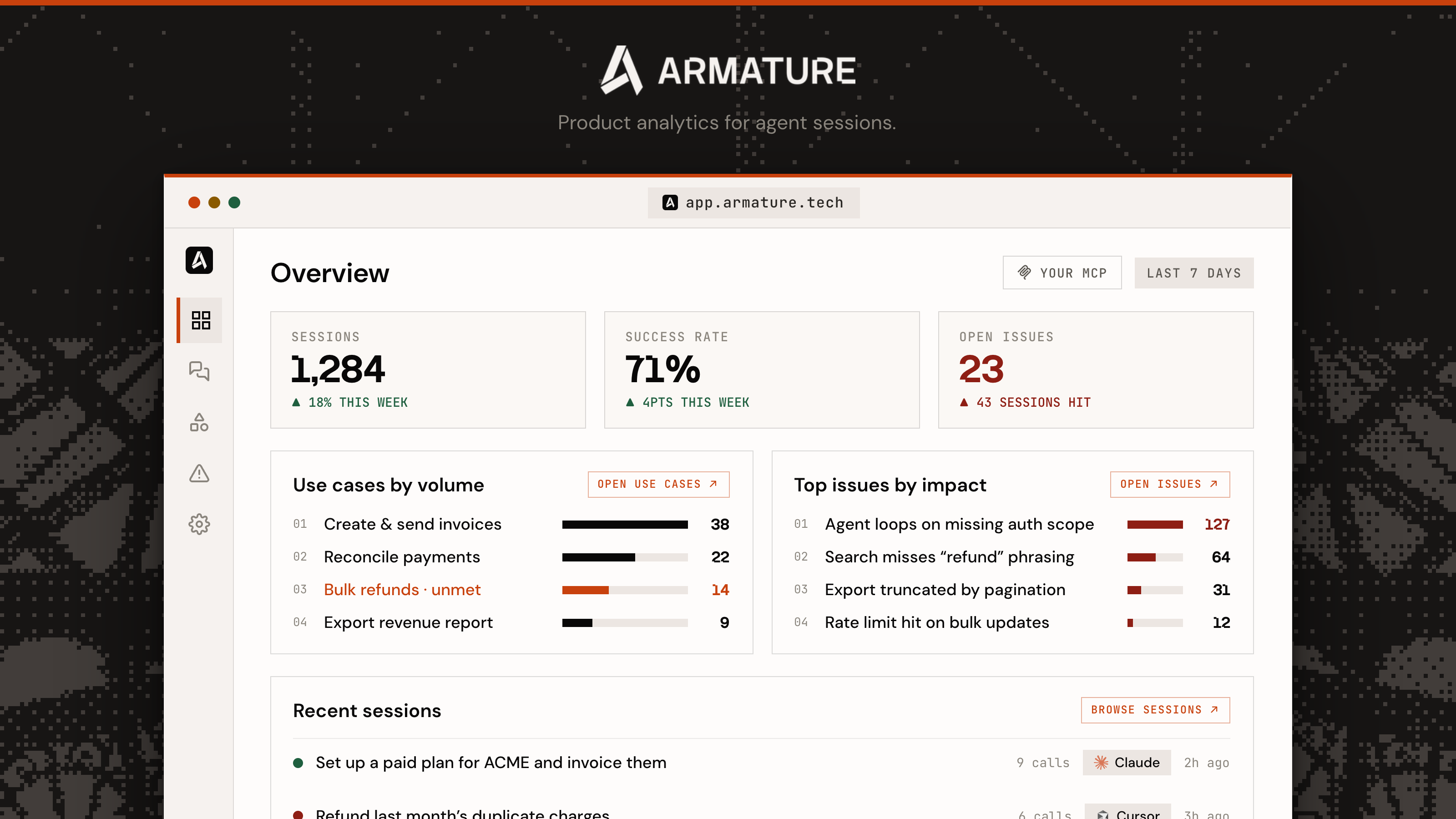
We shipped agents to millions of users. We built observability products. We lived the pain, so we built the product we needed: reconstruct the session, cluster what people actually came to do, rank what’s breaking.
Our product, in three pillars
Sessions. Every conversation rebuilt: what the user asked, how the agent reasoned, every tool it called, and where it ended up.
Use cases. We cluster these sessions into what people actually do with your MCP, including the workflows you never designed for.
Issues. The failures breaking the sessions, even without a thrown error, so you know what to fix first, and what to build next.
See → Understand → Fix. The self-improving software loop.
Our product’s three pillars aren’t separate features: they form a loop, which your agents close.
Because Armature itself exposes an MCP, any coding agent can read the issues, pull the related sessions, and ship the fix.
And very soon already, we’ll release our testing product to let Armature verify the fixes to the issues it identified.
Our vision: the Agent Experience
Thanks to what Armature is today, you’re not blind anymore: the lights are back on. But this might be the smallest part of what got lost. The smallest but the one all others depend on.
Seeing is step one, but the real casualty is growth.
Today’s UX is a stack of products answering acquisition, monetization, optimization, and retention. They all assume there’s a human behind a screen.
Every software company is asking the same questions.
- How do you upsell a premium feature to an AI agent?
- How do you build loyalty with a user that feels nothing?
- How do you support an agent that failed silently?
- How do you A/B test when there’s no screen to test?
UX had decades to build its tooling. We believe AX gets months.
We started with the layer everything else is built on: seeing.
Next, we help software companies understand how they can keep growing while the user shifts from humans clicking on a UI to agents hitting an agent-facing interface.
Armature is globally available
The product is self-serve, easy to install, offers a generous free tier, and SDKs available for TypeScript, Python or Go!
Please reach out to us with any question or feedback you have.